
BridgeMAIT assisted transportation service operates a fleet of vehicles specifically designed for transporting wheelchair users to and from the airport.
Requirements for Airport Transfers for Wheelchair Users
When providing airport transportation for wheelchair users
- Wheelchair users and their companions can board and disembark safely, securely, and quickly at the airport drop-off area
- Passengers can travel in comfort without compromising functionality or comfort, even when carrying a lot of luggage
- The vehicle has minimal side-to-side sway and vibration, allowing passengers with conditions such as spinal cord injuries to travel with minimal stress
In many cases, these requirements must be met simultaneously; in particular, standard vans are originally designed as commercial cargo vehicles, so they may lack ride comfort and interior space when used as-is.
To address these challenges, our company has designed and implemented structural mechanisms that meet the following requirements in a lawful and appropriate manner.
- The Toyota HiAce Wide Super Long Body (Well Cab) with its spacious interior
- 4WD drivetrain + LSD (a device that stabilizes power delivery), ideal for safe driving in bad weather and on rough roads
- Suspension system that controls the vehicle's natural frequency and amplitude
- A seating arrangement that allows passengers to board comfortably even when the vehicle is fully loaded
Comparison of Vehicles Used for Airport Transfers for Wheelchair Users
Let’s compare Wheelchair Accessible Private Transfer —specifically, BridgeMAITWheelchair Accessible Private Transfer —with the standard vans Wheelchair Accessible Private Transfer. However, we have excluded Universal Design "UD" Taxi (JPN Taxis) from this comparison.
- Vehicle Profiles for Comparison
| Comparison Criteria | BridgeMAIT vehicle | Standard HiAce | Standard Caravan |
|---|---|---|---|
| Base vehicle | Toyota HiAce 200 Series (Well Cab) | Toyota HiAce 200 Series | Nissan Caravan E26 Series (Chair Cab) |
| Body Dimensions | Wide, Super Long, High Roof | Standard width, long, high roof | Standard Width, Super Long, High Roof |
| Interior Area | 約7.3㎡ | 約4.6㎡ | 約5.3㎡ |
Safe Driving Performance for Wheelchair Users
- Wheelchair users sit higher inside the vehicle than typical passengers, and because they are supported by the mechanical structure of the wheelchair between themselves and the vehicle body, they are more sensitive to the instability the vehicle experiences on the road surface than typical passengers.
- In particular, when driving on expressways in adverse weather conditions—such as rain, snow, or strong winds—drivers may feel anxious or stressed unless they can keep the vehicle as stable as possible. There are limits to what a driver’s skill and attention alone can achieve.
- BridgeMAIT feature a 4WD drivetrain, an LSD mechanism for enhanced driving stability, and tires with excellent water drainage, resulting in a rugged and safe driving design that sets them apart from standard vans.
| Comparison Criteria | BridgeMAIT vehicle | Standard HiAce | Standard Caravan |
|---|---|---|---|
(Basic driving stability) | 4WD (advantageous in bad weather and on rough roads) | 2WD (at a disadvantage in bad weather and on rough roads) | 2WD (at a disadvantage in bad weather and on rough roads) |
(Stabilization of wheel speed differences) | Torque-sensing LSD (advantageous in crosswinds and on low-friction surfaces) | Open differential (disadvantageous in crosswinds and on low-friction surfaces) | Open differential (disadvantageous in crosswinds and on low-friction surfaces) |
| Tire | High load capacity + emphasis on drainage (low risk of hydroplaning) | High load + emphasis on service life (risk of hydraulic lock) | High load + emphasis on service life (risk of hydraulic lock) |
| Safety Summary | Designed to be less susceptible to adverse weather and road conditions, providing a stable ride on the highway | A design that is susceptible to adverse weather and poor road conditions, causing anxiety when driving on the highway | A design that is susceptible to adverse weather and poor road conditions, causing anxiety when driving on the highway |
Functionality as an airport shuttle vehicle exclusively for wheelchair users
- Wheelchair users and their traveling companions, who are often exhausted from long flights, need not only to have their wheelchairs secured safely and quickly, but also sufficient cabin space so that everyone—including the wheelchair user—can relax comfortably, even when the aircraft is loaded with a large amount of luggage.
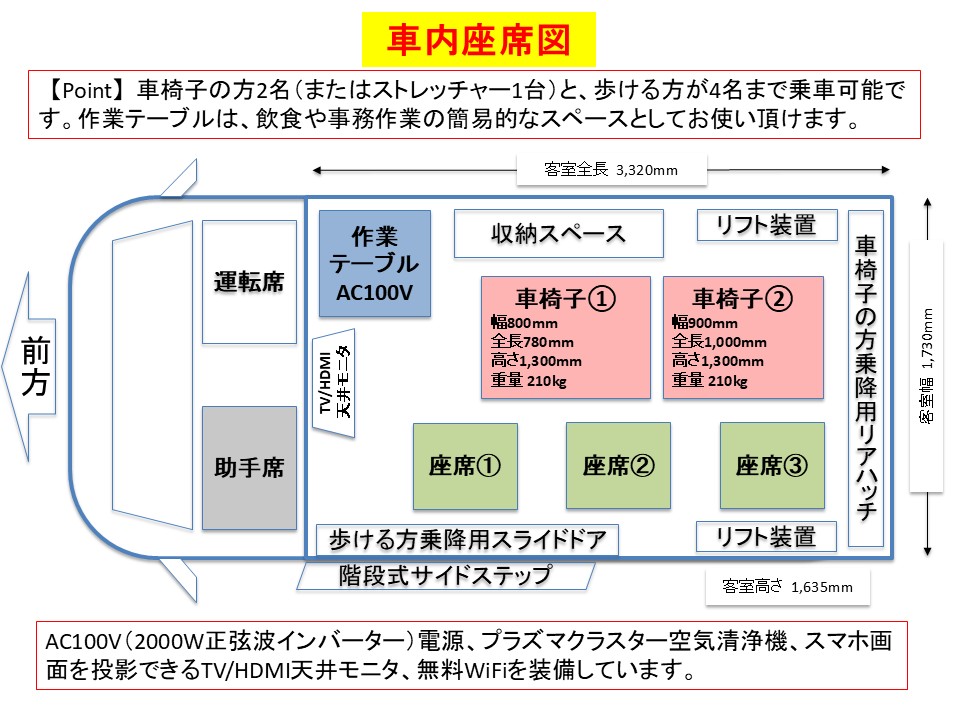
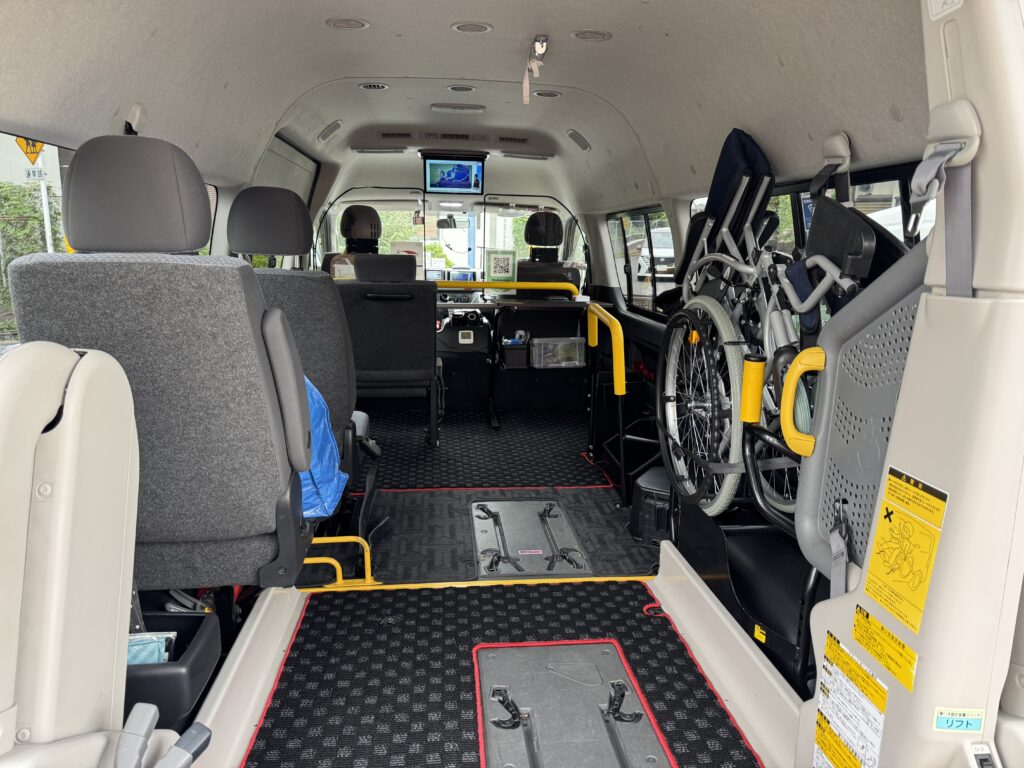
- BridgeMAIT have an interior area that is 2 square meters larger than that of a standard van, and the space for the electric wheelchair platform and the boarding area for accompanying passengers is also more than 20% larger.
- Unless specifically requested in advance, we avoid carrying large items such as stretchers, oxygen tanks, and specialized medical equipment as much as possible. Instead, we prioritize items that general travelers typically need—such as dedicated space for large suitcases, 100V/220V power outlets, and electronic devices—to enhance the vehicle’s functionality.
| Comparison Criteria | BridgeMAIT vehicle | Standard HiAce | Standard Caravan |
|---|---|---|---|
| Number of passengers | 2 people in wheelchairs 4 people who can walk | 2 wheelchair users 7 people who can walk | 2 wheelchair users 8 people who can walk |
| Cargo area: (excluding the seating area) | Approx. 2.1 m³ 18 extra-large suitcases | Approx. 0.8 m³ 6 extra-large suitcases | Approx. 0.7 m³ 7 extra-large suitcases |
| Wheelchair lift platform area | 約1.1㎡ | 約0.8㎡ | 約0.6㎡ |
| Area of the Tour Guide Boarding/Alighting Area | 約1.6㎡ | 約1.3㎡ | 約1.1㎡ |
| Side step area | 約0.3㎡ | 約0.2㎡ | 約0.1㎡ |
| Power Supply | 2000 Wh (100 V/220 V) No limit on continuous use | Less than 1000 Wh (100 V) Continuous use is limited | Less than 1000 Wh (100 V) Continuous use is limited |
| Information technology equipment | Ceiling monitor Free WiFi In-car microphone | Free Wi-Fi | Free Wi-Fi |
| Loading of Equipment Without Prior Request | None | Yes | Yes |
| Summary of Features | Fast baggage loading and unloading Fast and efficient passenger boarding and disembarking High baggage capacity | Cumbersome loading and unloading of luggage Acceptable passenger boarding and disembarking Low luggage capacity | Cumbersome loading and unloading of luggage Acceptable passenger boarding and disembarking Low luggage capacity |
High-Quality In-Vehicle Comfort for Wheelchair Users
- It goes without saying that wheelchair users experience greater physical strain and stress from the vehicle’s up-and-down, side-to-side, and jolting movements than regular passengers do.
- People with conditions such as spinal cord injuries—where high levels of vibration acceleration place a significant strain on the body—must exercise particular caution when driving on highways. The energy generated by road bumps is nearly double at highway speeds of 80 km/h or higher compared to typical urban driving speeds of 60 km/h or less.
- BridgeMAIT have undergone a complete redesign of their suspension system and interior space compared to standard vans, with the aim of reducing the physical strain on wheelchair users during high-speed travel. The suspension system has been optimized through a comprehensive analysis of factors such as spring rates, shock absorber damping rates, frame torsional stiffness, tire pressure, and maximum load capacity.
| Comparison Criteria | BridgeMAIT vehicle | Standard HiAce | Standard Caravan |
|---|---|---|---|
| A sense of openness in the room | Removing the second-row seats creates a much more spacious feel | There's no sense of openness because there are so many seats | There's no sense of openness because there are so many seats |
(converted value per seat) | 約1.4㎥ | 約0.7㎥ | 約0.8㎥ |
| Roll (Tilt) Suppression | Vehicle Stability Control System | None | None |
| Shock absorber | Softer (custom order) | firm | Slightly firm |
| Wide stroke width Soft | Narrow stroke width Firm | Medium stroke width Soft | |
| Leaf Spring (Spring Rate) | Passenger Use, Softer (Custom Order) | Firm for cargo | Standard Freight |
| Summary of Comfort | Spacious interior Smooth ride with minimal vibration Passenger car-like ride | Cramped living spaces Bounce and roll Ride quality of commercial trucks | Cramped living space Front-to-back pitch and roll Ride quality of commercial trucks |
BridgeMAIT vehicles are,
- Safe Driving Performance for Wheelchair Users
- Functionality as an airport shuttle vehicle exclusively for wheelchair users
- High-Quality In-Vehicle Comfort for Wheelchair Users
Our design prioritizes the needs of wheelchair users, aiming to make airport transfers and long-distance travel with heavy luggage more comfortable and safe.